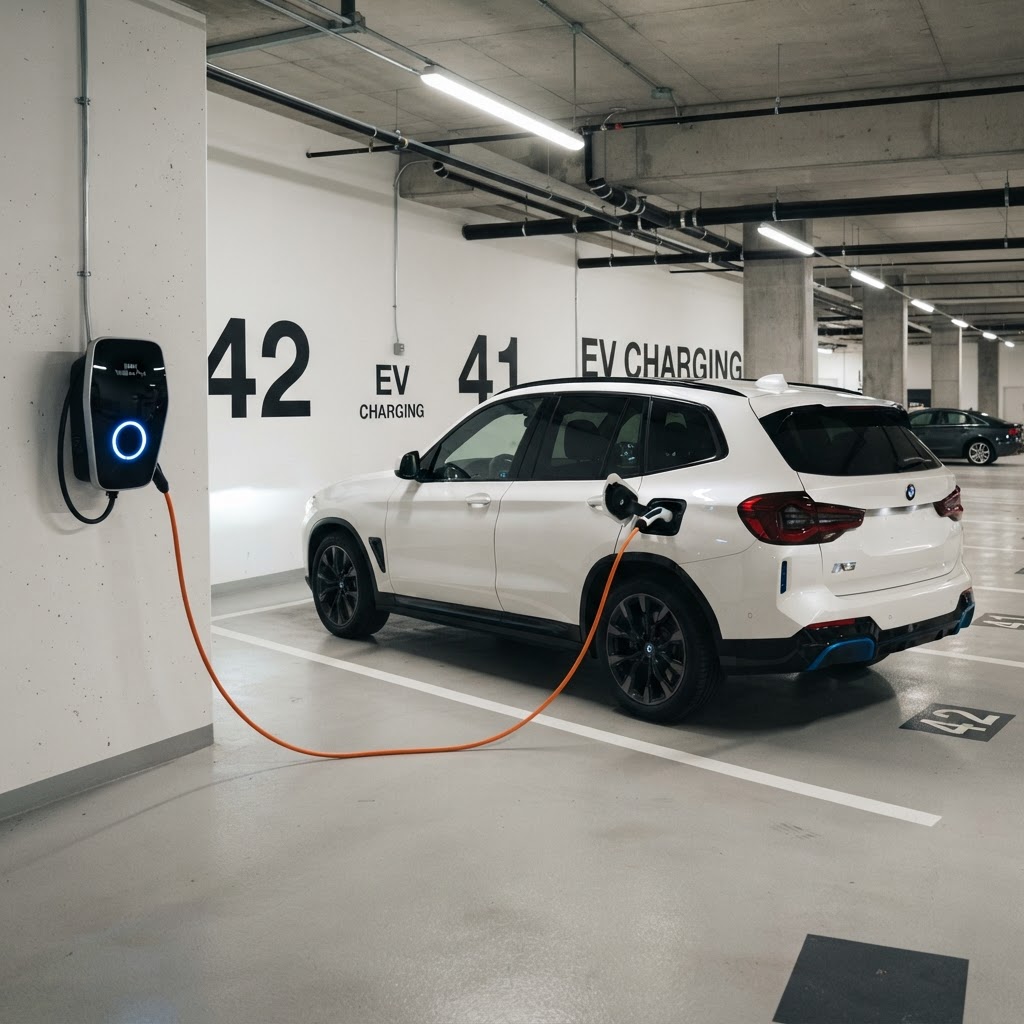
EV Charging Is Growing Fast. Should Monopoly Networks Own the Chargers?
Executive Summary
A NSW parliamentary inquiry has forced a question to the surface that could shape how Australia builds out its electric vehicle (EV) charging network for years to come: should monopoly electricity distribution networks — the companies that own the poles and wires — be allowed to own and operate EV chargers too? The Australian Energy Market Commission (AEMC) is now weighing a national proposal that would let them do exactly that, and the outcome will help decide who builds Australia's charging infrastructure, and who ends up paying for it.
Background
Australia's EV numbers are no longer a rounding error. More than 454,000 EVs are now on Australian roads, and EVs made up 13.1% of new car sales in 2025, up from 9.6% the year before. Growth has kept accelerating into 2026, with EVs accounting for more than a third of new passenger vehicle sales in June. Globally, more than 20 million electric cars were sold in 2025 — roughly one in every four new cars sold worldwide.
Most EV charging still happens at home overnight. But that assumes a driveway or garage with power access, something apartment residents, renters and many inner-city households don't have. For them, access to charging on or near the street they live on is likely to matter far more than it does for a household with off-street parking.
This is where "kerbside charging" comes in: relatively slow chargers (under 24kW) installed on residential streets, letting a car top up while it's parked rather than requiring a trip to a dedicated charging station. It's a model particularly suited to inner-city and higher-density areas where most cars are parked on the street rather than in a driveway.
What Happened
Energy Networks Australia (ENA), representing the distribution networks, has proposed to the AEMC that networks be allowed to install and maintain kerbside EV chargers as a regulated service — meaning the cost of building and running them would be recovered through regulated network charges, the same mechanism used to fund poles, wires and substations, and paid by all electricity customers regardless of whether they drive an EV.
The idea was tested first in NSW, where a proposal for Ausgrid, Endeavour Energy and Essential Energy to install 13,720 slow kerbside chargers went before a state parliamentary inquiry. The inquiry's report recommended against the rollout in its current form, warning it risked market distortion, reduced innovation and higher costs for consumers. It did, however, acknowledge genuine charging gaps exist, and recommended Essential Energy work with state and local government to address charging "black spots" in regional areas specifically — a much narrower role than the original proposal.
Under ENA's model, networks wouldn't sell electricity directly to EV drivers. They would own and maintain the physical charging hardware, while retailers and commercial charging companies would compete to provide the actual customer-facing charging service through that infrastructure — similar in structure to how retailers already compete to sell electricity over network-owned poles and wires.
Market Impact
The core tension is about market structure, not whether more chargers are needed — there's broad agreement they are.
Electricity distribution networks are natural monopolies: households can't choose a different network operator, so network revenue and investment is tightly regulated by the Australian Energy Regulator (AER). EV charging, by contrast, is currently an open, competitive market — private charging companies, retailers and other investors can choose locations, set prices and compete on service.
Allowing a monopoly network into that market changes the competitive dynamic. A private charger operator has to raise its own capital, pay for its own grid connection, and recover costs only from customers who actually use its chargers. A network already owns the pole, controls the connection, and — under this proposal — could recover its charger costs from all electricity customers through regulated charges, whether or not they ever use a kerbside charger. This is the exact scenario "ring-fencing" rules are designed to prevent: monopoly businesses using their regulated position to gain an advantage in markets that are meant to stay competitive.
There's also a longer-term dimension. Chargers aren't just hardware — they're a gateway to smart charging, dynamic pricing, demand management and vehicle-to-grid (V2G) services, an increasingly valuable layer of the energy system as EVs, batteries and solar give households a bigger role in how electricity flows. If networks build a foothold through slow kerbside chargers today, some industry watchers see that potentially extending network influence into these adjacent, currently-competitive markets over time.
Why It Matters
For most households, there's no immediate bill impact from this decision alone — the proposal is still under AEMC review, and the NSW version has already been sent back for a narrower, more targeted approach. But the outcome of this debate matters for anyone who could someday rely on kerbside charging, and for every electricity customer more broadly, since regulated network charges are built into everyone's bill regardless of whether they drive an EV.
Renters, apartment residents and households without off-street parking have the most direct stake — they're the ones most likely to actually need kerbside charging rather than home charging. Regional households are also relevant to this debate specifically: the NSW inquiry's compromise recommendation focused on networks helping close charging gaps in areas private investment is unlikely to reach, rather than a broad rollout everywhere.
More broadly, this case is being watched as a test of where the line sits between regulated monopoly infrastructure and competitive energy markets — a boundary that will keep coming up as home batteries, solar and EVs create more new, potentially fundable-by-network services in the years ahead.
Key Takeaways
- EVs made up 13.1% of new car sales in Australia in 2025, with more than 454,000 EVs now on the road nationally
- Energy Networks Australia has proposed that monopoly distribution networks be allowed to own kerbside EV chargers as a regulated service, recovering costs through charges paid by all electricity customers
- A NSW parliamentary inquiry recommended against a proposed 13,720-charger rollout by Ausgrid, Endeavour Energy and Essential Energy, citing risks of market distortion and higher consumer costs
- The inquiry did recommend a narrower role for Essential Energy in addressing regional charging black spots
- The core concern is ring-fencing: preventing regulated monopoly businesses from using their protected position to gain an advantage in markets — like EV charging — that are meant to stay competitive
- The AEMC's Electricity Network Regulation Review is using this case to help decide the broader boundary between regulated network services and competitive energy markets
- No national rollout or AEMC decision has been confirmed yet
Last reviewed: 13 Aug 2026
Unlock GridMate for $10/month
Get full access to all guides, market insights and bill analysis tools.
Currently supports single-rate tariffs. Time-of-use and controlled load support coming soon.
Already a member?